Person: The International Dimension to the American Revolution
Britain’s long term interest lay in protecting the strategic waters of the Caribbean. Whether it be Jamaican planters or royal officials, protecting the West Indies and the commerce it created was at the forefront of decision making. In particular, British officials like Admiral George Rodney had shipping and trade implications in mind when dealing with the imperial crisis that arose in America. Discussions of trade and shipping did not simply encompass that of North America and the colonies: The American Rebellion became a competition for hegemony between the French, British, and Spanish empire. After an extensive naval career, Admiral Rodney was celebrated for fending off the French in the West Indies[1]. Rodney’s correspondence as well as his depictions in the British public illustrate the international dimension to the American Revolution. Saving Britain’s prized colonial possessions restored the prestige of the British military, but it also diverted manpower and attention from the North American theater. In the process Britain more or less ignored the northern theater that eventually slipped away and focused their attention on the Caribbean.
Even before the war truly heated up in the Caribbean, Admiral Rodney focused on the commercial problems facing British ships in Jamaica. The lack of security in the Caribbean was already in the minds of the British who were worried about French and Spanish interference. The Free Port Act of 1766, which permitted French and Spanish ships access to British ports, hindered the competiveness of British merchants. In 1774 letter intended to a British official, Rodney makes it clear that French ships are “detrimental to the public service.”[2] He passionately writes that ever since the Spanish and French ships are allowed free entry into Jamaica, “the commerce in British bottoms has totally ceased.”[3] Admiral Rodney’s focus on the commercial advantage is consistent with longstanding British policy towards commerce, namely the protection of British commerce over that of other empires. He makes clear to the Lordships that this policy is not in the interest of the mother country for the French have an “opportunity of smuggling an amazing quantity of the manufactures of France”[4] In other words, Rodney is vigorously opposed to the French interference in Jamaica’s economy. Not only does he take issue with the commercial advantage of the French, but Rodney also distrusts the character of the French and those on the mainland who sell their products. Rodney’s antisemitism is quite clearly seen when he writes about the Jewish merchants who aid the French by “carry[ing] on a most pernicious commerce, and employ[ing] vessels which at St. Domingo are French, at Jamaica English.”[5] Rodney associates the French with Jewish merchants—a group he clearly distrusts. His correspondence is emblematic of someone who is focused beyond the immediate problems of North America or a narrow elite. Rodney situates Jamaica within the larger context of the British empire, vying for competiveness with the French and Spanish. Interestingly, at the end of his correspondence with Phillip Stevens, Rodney portends that the French could “disturb the tranquility of Jamaica” because of their intimate knowledge of the ports and harbors of Jamaica.[6] Rodney was not far from the truth.
Just as the North American theater of the war winded down the with the defeat of the British at Yorktown, the Caribbean began to heat up.[7] Historian Andrew O’Shaughnessy argues that Rodney probably contributed to the defeat at Yorktown by sending some of his fleet to Jamaica and by leaving to Britain to protect his legacy.[8] Diverting troops from North America to protect Jamaica from an impending French and Spanish attack demonstrates Rodney’s focus on the Caribbean. To be sure, there were probably personal interest as well, but Rodney’s focus on the Caribbean was made clear by his actions. Britain quickened the removal of troops from the southern states and sent many of them to Caribbean.[9] The international dimension of the American rebellion became more evident as the French, Spanish, and British vied for the Caribbean.
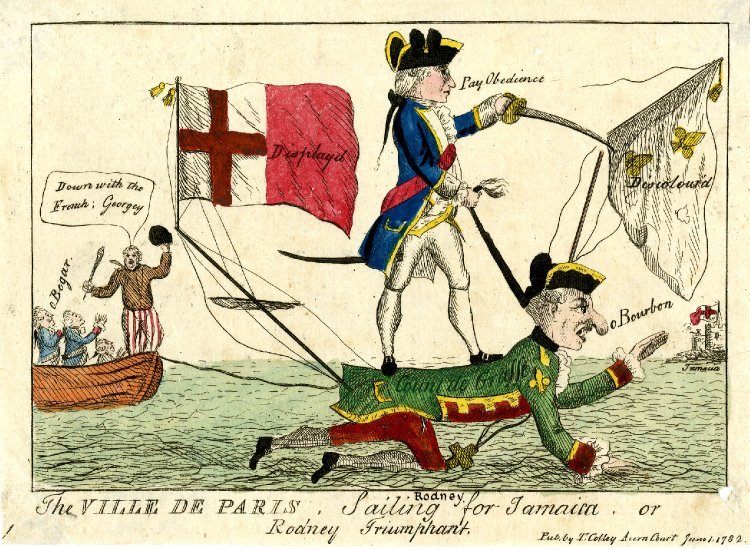
Through his actions in the Battle of the Saintes in 1782 Admiral George Rodney restored his legacy by fending off the French in the Caribbean. Rodney became a hero in the British public: his other previous blunders were largely ignored as the public celebrated the preservation of the British empire in the Caribbean. Cartoons such as Gillray’s “The Ville de Paris Sailing for Jamaica, or Rodney Triumphant” illustrate just how much the British saw him as a hero. In Gillray’s cartoon Rodney triumphantly rides the French Admiral De Grasse to Jamaica, while a group of French officers submissively beg to a cheering British sailor.[10] Through his triumph in the West Indies Rodney restored the legitimacy and prestige of the British navy. The American Revolution evolved into a war between the French and the English.[11] Interestingly, the lens through which many British viewed Rodney—illustrated in Gillray’s cartoon—reveals how quickly many British looked for reassurance of the strength of the empire. Britain had suffered setback after setback in the north, but the public clung on to hope of the British empire by celebrating a victory won in a traditional fashion against an established player. To be sure, Britain’s desire to keep Jamaica was grounded in practicality. After all, it was Britain’s wealthiest colony. Yet by focusing on war between empires in the West Indies, Britain lost its control of its colonies in the North.
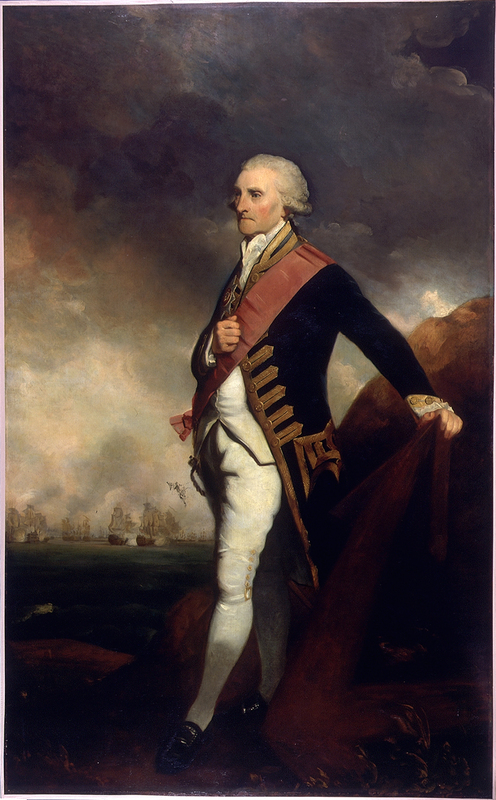
Similarly, Joshua Reynold’s painting of Admiral Rodney in 1788 reinforces the international dimension of the American Revolution and Britain’s attempt at finding hope even after suffering multiple setbacks.[12] In the oil painting, Rodney confidently rests his hand on one of Britain’s colonial possession as he is flanked by a fleet of warring ships. Interestingly, the painting has a dark composition except for the depiction of the confident Rodney and the ships in the background. Perhaps, Reynolds is trying to underscore the continued importance and strength of the British navy. Rodney’s firm and confident footing in the midst of the British empire losing so much of its territory in North America demonstrates how many British looked for comfort in a traditionally won battle. Not unlike Gillray’s cartoon, there is no depiction of the strategic errors made by the British in deciding to hasten the removal of troops from the southern states. The depictions of Rodney not only underscore an international dimension to the war—because of the fighting between empires—but they also highlight an accomplishment that probably came at the cost of controlling the northern colonies.
The economic concerns of maintaining control of the colonies weighed heavily in the minds of British officials like Admiral Rodney. If anything, Rodney’s correspondence and depictions offer a glimpse into the international dimension of the American Revolution. Expelling the French from the West Indies may have come at the cost of losing the key battles in the North, yet Britain retained control of its most sacred possessions: the strategic waters of the Caribbean and the productive lands of Jamaica.
Word Count: 1200
Bibliography:
Duval, Kathleen. Independence Lost: Lives on the Edge of the American Revolution. New York: Random House, 2015.
Gillray. The Ville De Paris Sailing for Jamaica or Rodney Triumphant. 1782. Sketch. British Museum, London.
Mundy, Major General. The Life and Correspondence of the Late Admiral Rodney. London: John Murray, 1830.
O'Shaughnessy, Andrew Jackson. An Empire Divided: The American Revolution and the British Caribbean. Philadelphia: University of Pennsylvania Press, 2000.
Reynolds, Joshua. First Lord Rodney. 1788. Oil on canvas. Royal Collection Trust, London.
[1] Andrew Jackson O'Shaughnessy, An Empire Divided: The American Revolution and the British Caribbean (Philadelphia: University of Pennsylvania Press, 2000), 237.
[2] Major General Mundy, The Life and Correspondence of the Late Admiral Rodney (London: John Murray, 1830), 136.
[3] Ibid., 136.
[4] Ibid., 137.
[5] Ibid., 137.
[6] Major General Mundy, 137.
[7] Andrew O’Shaughnessy, 232.
[8] Ibid., 232.
[9] Ibid., 232.
[10] Gillray, The Ville De Paris Sailing for Jamaica or Rodney Triumphant, 1782, sketch, British Museum, London.
[11] Kathleen Duval, Independence Lost: Lives on the Edge of the American Revolution (New York: Random House, 2015), 128.
[12] Joshua Reynolds, First Lord Rodney, 1788, oil on canvas, Royal Collection Trust, London.