A Debutante in the Revolution: Margarita "Peggy" Schuyler (Person)
 http://dighist.fas.harvard.edu/courses/2017/hist1002/files/original/2abe1cd19a0eb8a8dd4d6f3e629cf04f.pdf http://dighist.fas.harvard.edu/courses/2017/hist1002/files/original/b98332c40a374dc7d95dfdc6165802c4.pdf
 Albany and much of the Hudson River Valley was home several wealthy, land owning Dutch families. Margarita “Peggy” Schuyler was born to one such family, the third daughter of Philip Schuyler, a well-respected land owner in the midst of an illustrious military career who would become a prominent patriot. [1] Being a member of a prominent family in New York’s back-country could be difficult, even for a young girl with few responsibilities like Peggy. Born in 1758, about halfway through the Seven Years War, it’s unlikely that she would have remembered much of the fighting that occurred in her own backyard. [2] We can imagine that she would have absorbed the fear associated with living in an area prone to attack by belligerents like the Huadenosaunee from her mother, who had to raise several children and run the Schuyler Mansion, while her father was at war. [3][4]. Further, as the daughter of a wealthy landowner and military officer, her family was perpetually a potential target. [5] These conditions created a complex upbringing for this daughter of Albany, but an upbringing that created a stately, strong-willed young woman in a family of well-respected men and women.
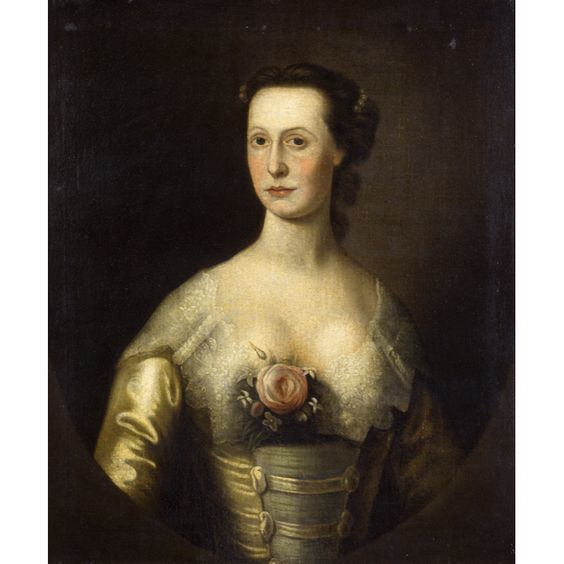
Peggy is surprisingly faceless, despite that it’s easy to find paintings of her parents and sisters in American museum collections. We can set this peculiarity aside, however, if we consider Peggy as she was leading up to and during the Revolution, a young woman in her teens and early twenties. It’s likely rare to have your portrait done so young. We can look to Thomas McIlworth’s painting Mrs. John Philip Schuyler, and that subject’s (her mother, Catherine) upbringing as a model for Peggy in her youth. [6]
Catherine Schuyler sat for this portrait between 1762 and 1767, sometime in her late twenties or early thirties. In a beautiful gold dress with lace trim holding her chin high, Catherine dresses and carries herself like a poised, wealthy woman. The title of the painting echoes the societal view of women of her age: wives before all else. She is, however, remembered as a strong, capable woman. She was the face of the Schuylers when Philip was away, which was often, for both military and political missions. She oversaw the household and her daughters’ education, and would have been a prominent role model in Peggy’s life. [7]
Much of what Peggy would have learned from her mother concerns the way a Dutch lady should comport herself. Mary Humphreys’s biography of Catherine tells us that the women of Albany remain connected to their Dutch roots and pride themselves in their warm hospitality. [8] Humphreys describes Catherine as being incredibly generous, quoting a visitor who observed that the poor of the frontier lands had “nothing adequate to their manner of living…But with regard to the plenty…of the table it was supplied from a variety of sources. Indians grateful for numerous benefits were constantly bringing the smaller game and in winter and spring loads of venison.” [9] The Schuylers owned vast amounts of land, much of which was farmed by slaves, and shared their harvest with the community. Catherine learned from her mother-in-law, Peggy’s namesake Margarita Schuyler, and would have passed these lessons to her daughters. [10]
The messages Peggy would have received with regards to Indians, however, may have felt somewhat contradictory to a young girl. Humphreys says that “Indian visitors were no strangers at prominent houses. The Schuylers had always been known as the friend of the Indian.” [11] She describes visitors of all levels of distinction from several Native American tribes like the South Carolinian Catawba and the more local Mohawks. [12]. We also know of hostile Native Americans tribes like the Huadenosaunee, who raided towns in upstate New York in protest to widespread violations of the Proclamation of 1763 by colonists. [13] These raids would be terrifying news to Peggy; how does such a young girl learn to differentiate between friendly and hostile groups—especially in an era when lumping tribes together was the norm? This, too, would have been a lesson from her mother, who was the head of the Schuyler household throughout the French and Indian War. While Philip was away fighting, Catherine both aided local colonists affected by raids and worked to keep peace with non-hostile tribes. [14] As similar events occurred during Peggy’s teenage and young adult years, she would have learned her mother’s level-headed poise and generosity, both towards her fellow colonists and towards local Native American tribes, teaching her ownership of her surroundings and empowering her to keep them at peace.
Though her father was often away, Peggy would have learned some important, though indirect, lessons from him as well. As the daughter of a General, Peggy would have learned how to act stately when entertaining high-profile guests. A letter from Benjamin Franklin and Samuel Chase to Philip Schuyler in 1776 praises the Schuyler family’s hospitality in Philip’s absence. [15] At this time, Peggy would have been 17, by no means a child, and would have needed to be a gracious hostess in her own right, alongside her mother. Being the daughter of the general also comes with its share of danger. The item titled “Glorious Authentic Intelligence” describes that the Schuyler estate was burned down after the Battle of Saratoga. [16] Peggy is also a target. Watching her mother remain composed during these sorts of events would likely have helped Peggy to internalize that same bravery.
Peggy is also the daughter of the head of a prominent family. In the advertisement “To be Let, or Sold…” we see an impressive quantification of this land, wherein Philip advertises over 9000 acres of land for sale. [17] As the daughter of the head of the Schuyler estate, she would likely recognize that when people see her name, they think of her father and his legacy, and that her behavior reflects on him. Especially as a young woman who has yet to gain public favor in her own right, Peggy might see her composure as a Dutch lady as a critical component of herself. Indeed, at the end of the war, Peggy marries Stephen Van Rensselaer III, the son of the head of another wealthy family in Albany. [18] Her elder sisters married men outside of the Albanian leading families. [19] Peggy would have had similar chances to meet other men in while near military camps like Morristown, indicating that Peggy may have believed that she would have a role to play as a leading lady of Albany. [20]
Peggy died at 42, less than ten years older than her mother was in her portrait, so it’s difficult to say whether she would have come into her own as a leading lady of Albany like her mother did. But, having lived with and learned from her mother for the duration of the war and the pre-war period, it’s likely that Peggy learned the same poise, wit, and sense of duty needed to run one of these visible, well-respected households. We can imagine that Peggy, given more time, would naturally follow in the footsteps of her mother.
Word Count: 1185
Footnotes:
- Taylor, Alan. American Revolutions: A Continental History, 1750-1804. (New York: Norton & Company, Inc., 2016.) 179.
- “Margaret Schuyler Van Rensselaer” Find A Grave Memorial. March 24, 2005. Accessed March 16, 2017. https://www.findagrave.com/cgi-bin/fg.cgi?page=gr&GRid=10665970
- Taylor, Alan. American Revolutions: A Continental History, 1750-1804. (New York: Norton & Company, Inc., 2016.) 57-59, 67-70.
- Humphreys, Mary Gay. Catherine Schuyler. (New York: Charles Scribner’s Sons., 1901). 16-17. Accessed March 16, 2017. http://thefederalistpapers.org/ebooks/the-life-of-catherine-schuyler
- “Glorious authentic intelligence. October 21st, 1777. Camp at Saratoga, October 12, 1777…” (Lancaster), 1777. Readex: America’s Historical Imprints. Accessed March 16, 2017.
- McIlworth, Thomas. 1962-1967. Mrs. Philip John Schuyler. Oil on canvas. New York: New-York Historical Society Museum & Library. http://www.nyhistory.org/exhibit/mrs-philip-john-schuyler-1734-1803
- Humphreys, Mary Gay. Catherine Schuyler. (New York: Charles Scribner’s Sons., 1901.) 13, 34, 41. Accessed March 16, 2017. http://thefederalistpapers.org/ebooks/the-life-of-catherine-schuyler
- Ibid.
- Ibid., 36
- Ibid.
- Ibid., 120
- Ibid., 119-124
- See 3.
- Humphreys, Mary Gay. Catherine Schuyler. (New York: Charles Scribner’s Sons., 1901.) 13-17. Accessed March 16, 2017. http://thefederalistpapers.org/ebooks/the-life-of-catherine-schuyler
- “The Commissioners to Canada to Philip Schuyler, 1 May 1776,” Founders Online, National Archives, last modified December 28, 2016, http://founders.archives.gov/documents/Franklin/01-22-02-0245. [Original source: The Papers of Benjamin Franklin, vol. 22, March 23, 1775, through October 27, 1776, ed. William B. Willcox. New Haven and London:: Yale University Press, 1982, pp. 415–416.]
- “Glorious authentic intelligence. October 21st, 1777. Camp at Saratoga, October 12, 1777…” (Lancaster), 1777. Readex: America’s Historical Imprints. Accessed March 16, 2017.
- “To be Let, or Sold,…” New-York Gazette (New York), March 28, 1763. Readex: America’s Historical Newspapers. Accessed March 16, 2017.
- Siry, Steven E. “Van Rensselaer, Stephen” American National Biography Online. February 2000. Accessed March 16, 2017. http://www.anb.org.ezp-prod1.hul.harvard.edu/articles/03/03-00510.html
- “To Alexander Hamilton from Marquis de Fleury, 20 October 1780,” Founders Online, National Archives, last modified December 28, 2016, http://founders.archives.gov/documents/Hamilton/01-02-02-0917. [Original source: The Papers of Alexander Hamilton, vol. 2, 1779–1781, ed. Harold C. Syrett. New York: Columbia University Press, 1961, pp. 481–483.]
- “From Alexander Hamilton to Elizabeth Schuyler, [17 March 1780],” Founders Online, National Archives, last modified December 28, 2016, http://founders.archives.gov/documents/Hamilton/01-02-02-0622. [Original source: The Papers of Alexander Hamilton, vol. 2, 1779–1781, ed. Harold C. Syrett. New York: Columbia University Press, 1961, pp. 285–287.]